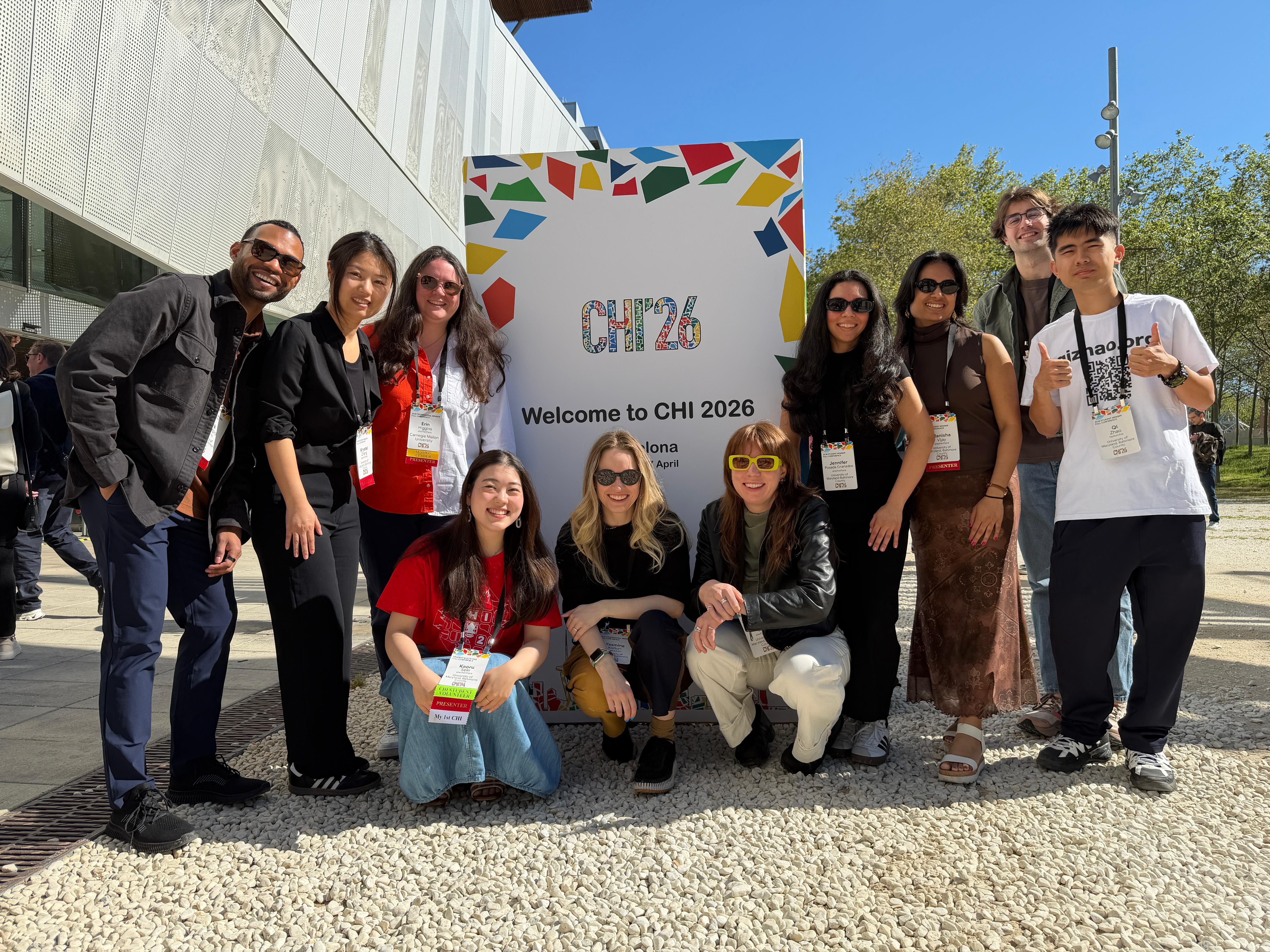
The Kotturi Lab Goes to CHI 2026
Published:
We are thrilled to share that the Kotturi Lab presented two papers and a poster at CHI 2026 in Barcelona. Just as meaningful as the work itself: this was the first CHI for all of our students, and for Kaoru, Manisha, and Qi, the first academic conference of any kind. Watching them give their first talks, run their first poster session, and find their footing in a room of thousands was the highlight of the week.
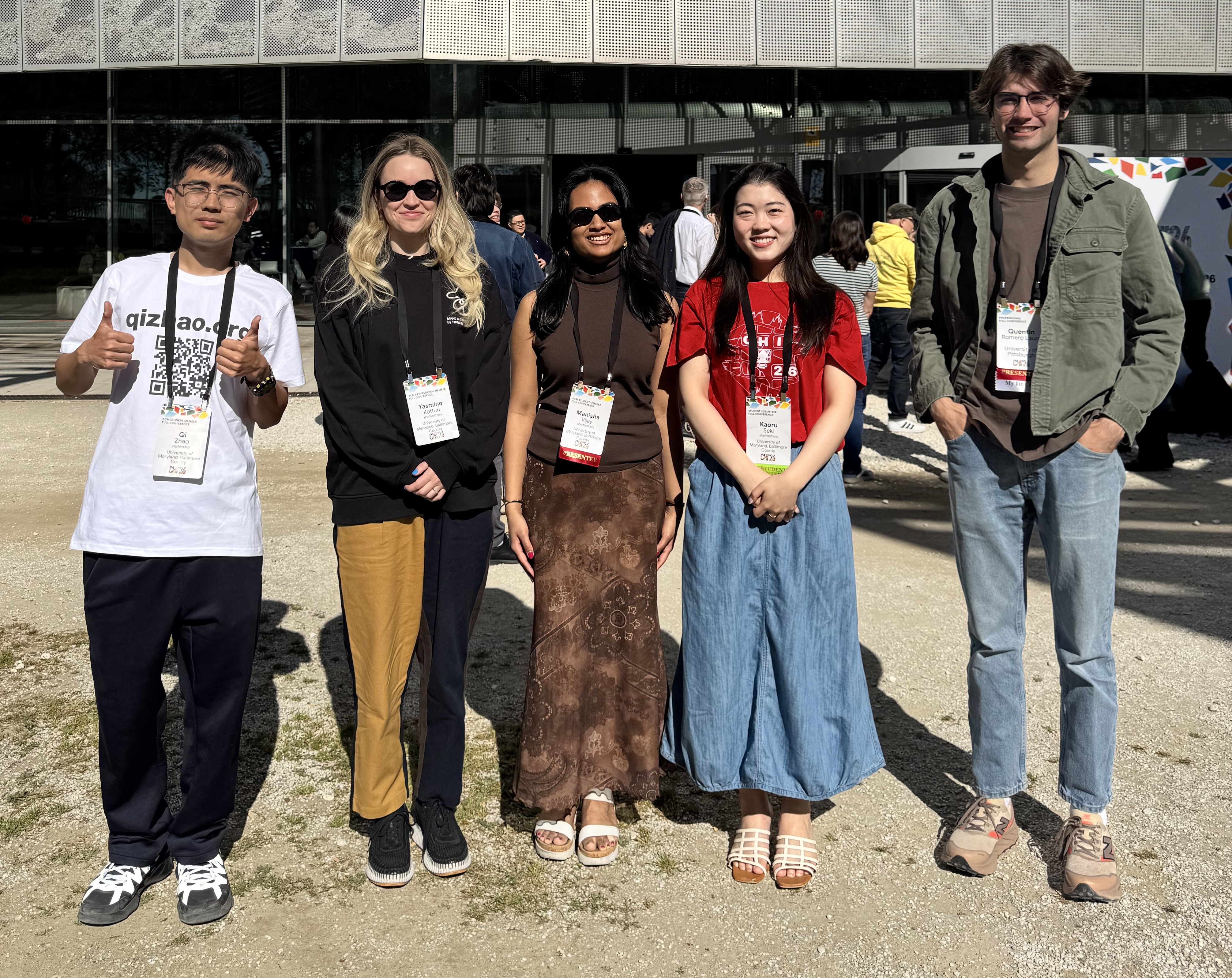
Our two accepted papers — Participatory, not Punitive: Student-Driven AI Policy Recommendations in a Design Classroom and Towards Designing for Resilience: Community-Centered Deployment of an AI Business Planning Tool in a Small Business Center — reflect our ongoing commitment to human-centered AI, participatory design, and community-engaged research. We’re grateful to our collaborators and students who made this work possible.
Participatory, not Punitive
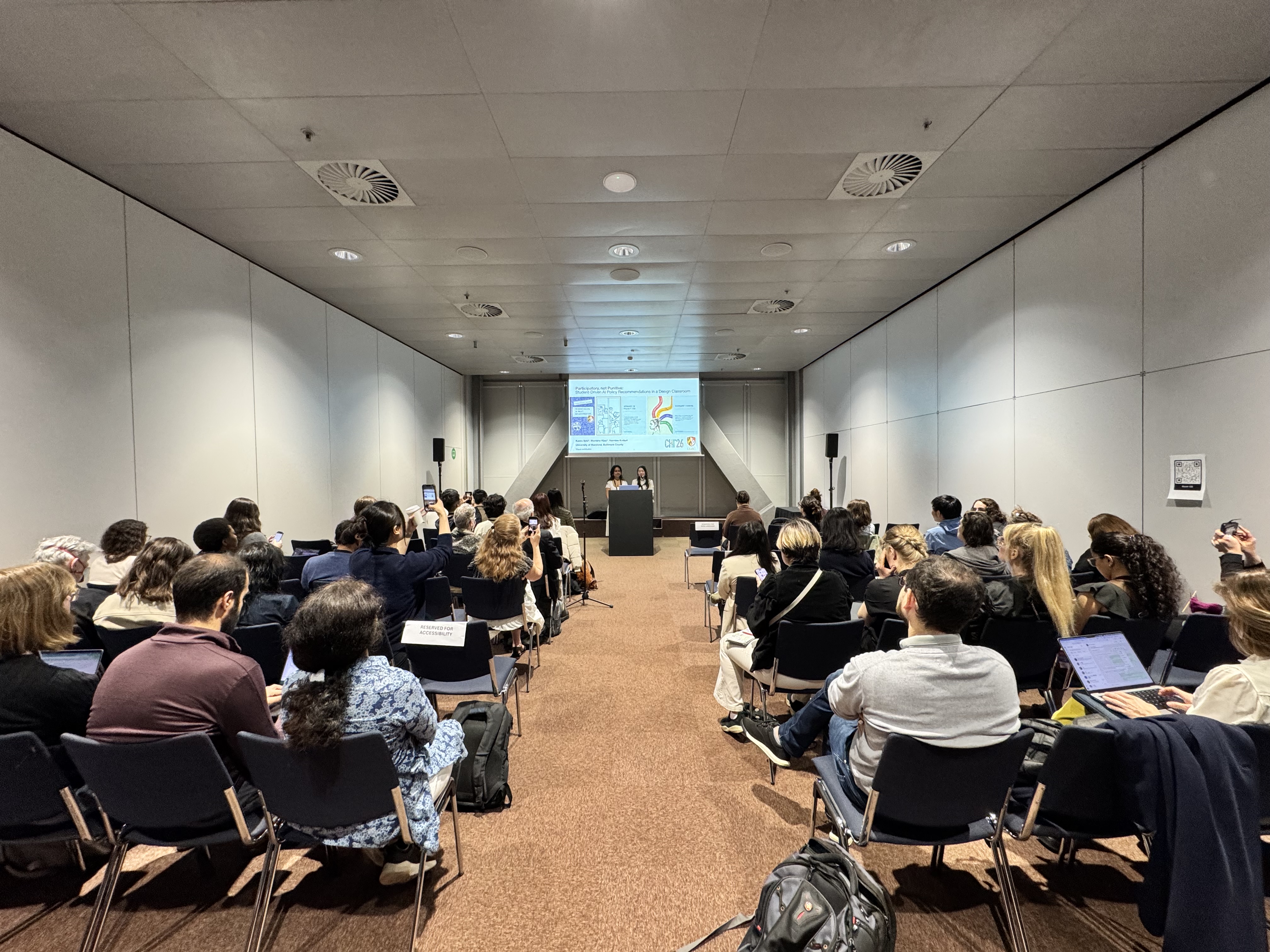
Kaoru Seki and Manisha Vijay presented our paper on student-driven AI policy design in the classroom. The work grew out of a participatory design workshop series where students drafted their own AI policies for a design course and visualized their recommendations in a zine.
In a lovely touch, Kaoru and Manisha handed that zine out to the audience during the talk itself — putting the research literally into people’s hands and sparking conversations the moment they stepped off the stage.
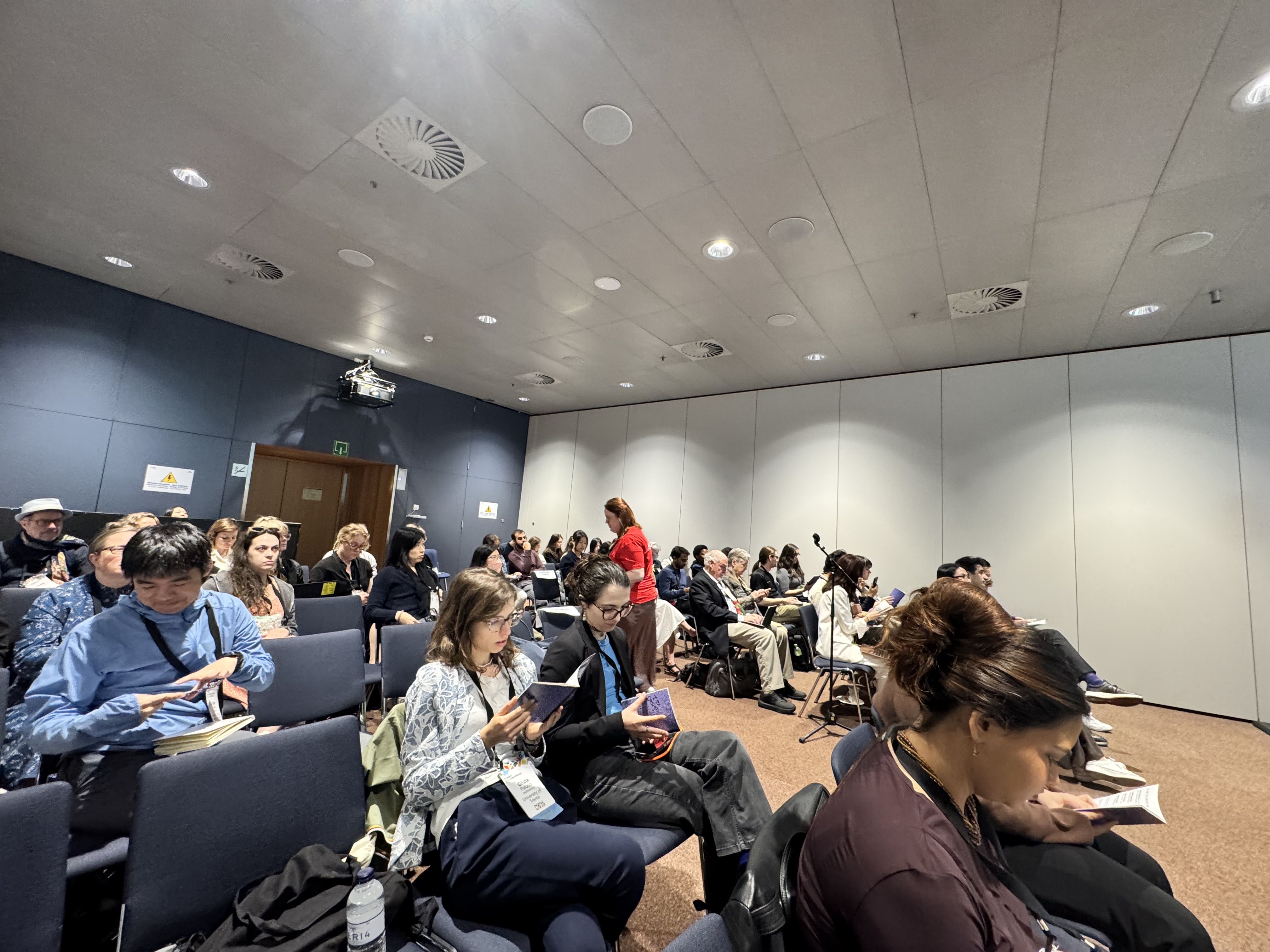
The session drew real interest in carrying the work forward, including from faculty curious about turning the process into a replicable model for student-informed GenAI policy across institutions.
Towards Designing for Resilience
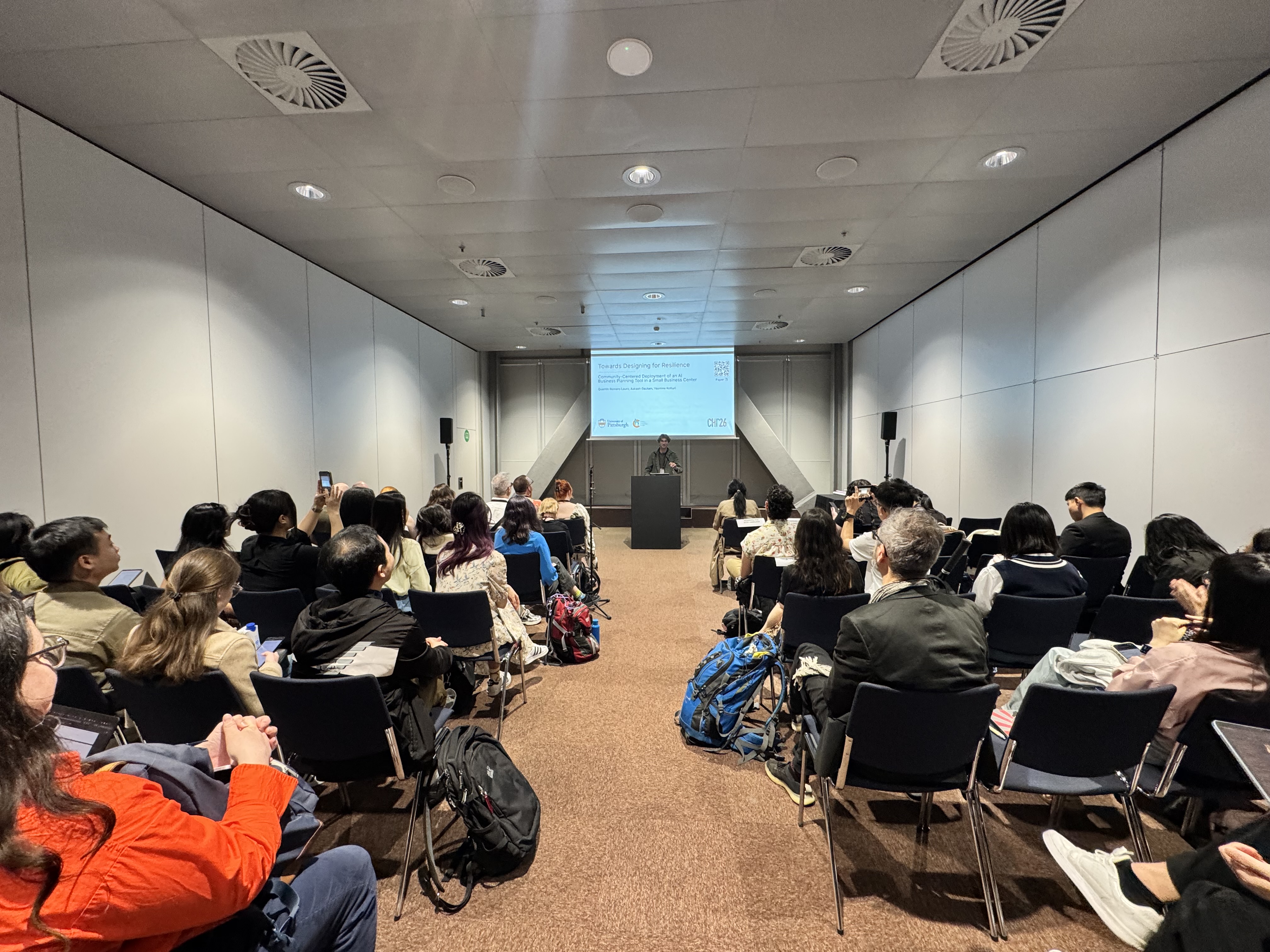
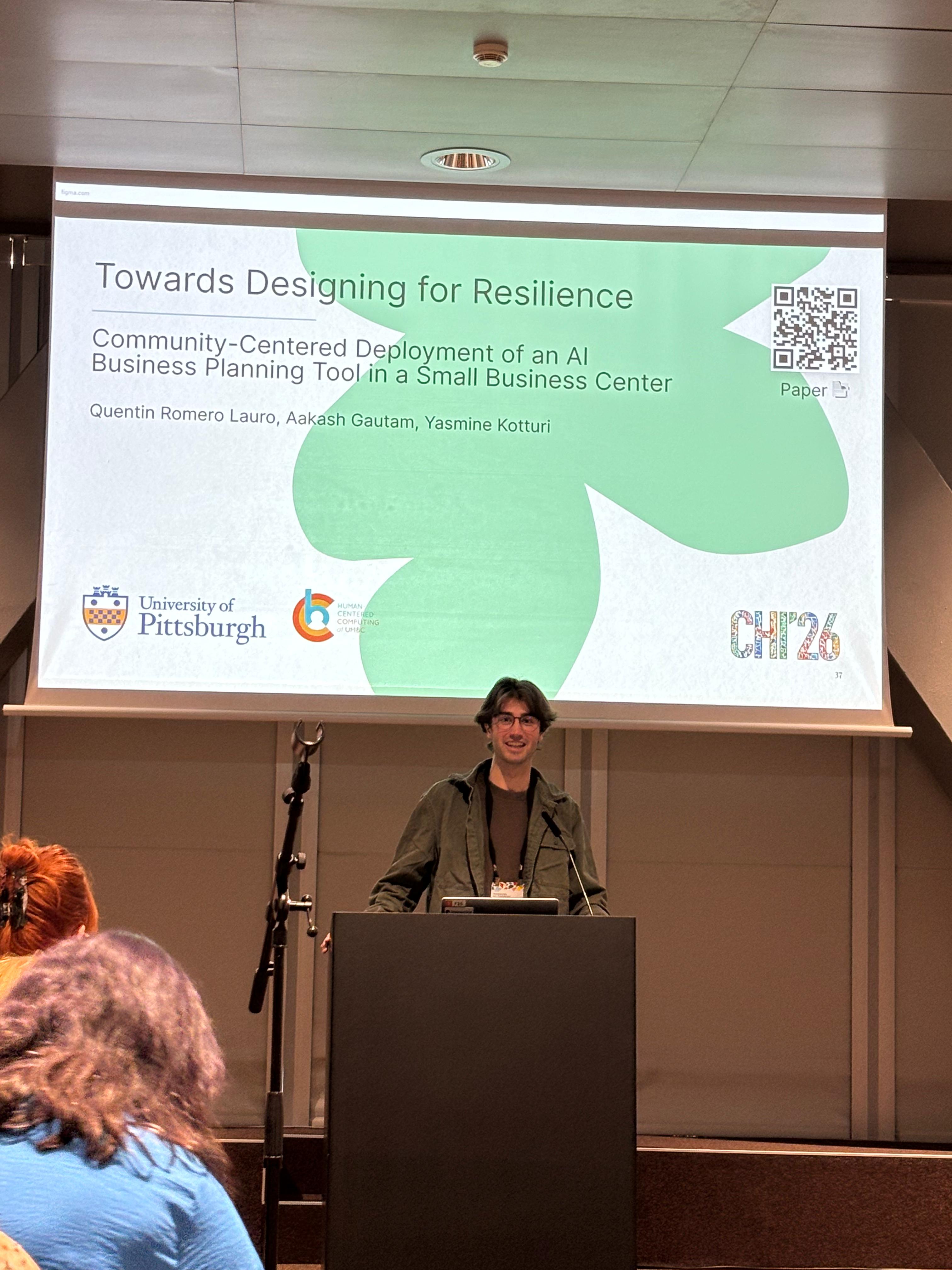
Quentin Romero Lauro presented our paper on the community-centered deployment of BizChat, an AI business-planning tool — work grounded in a real-world community partnership rather than a controlled lab study.
A First Poster
Qi Zhao presented his poster, “I don’t feel lonely because I don’t work alone most of the time”: Exploring Gig Work as an Opportunity for Social Participation Among Older Adults — his first paper as first author, drawn from his master’s thesis. He talked with roughly 25 people over the session (including a few researchers whose names he’d only ever seen on papers), handing out homemade cookies stamped “Kudos” along the way.
First CHI, In Their Words
Given that this was their first time at CHI, we asked Kaoru, Manisha, and Qi to write down their reflections on the week. A few highlights.
Kaoru served as a student volunteer, which gave her a behind-the-scenes view of how the conference runs — and, during one shift, an unexpected invitation into a closed workshop on restoring human authenticity in AI-mediated communication. The conversation connected directly to her PhD interests and surfaced design ideas she’s still chewing on, like interfaces that show writing side-by-side in a user’s native language so they can preserve their own voice. When it came time to present, handing the policy zine to the audience turned the talk into a two-way exchange and led to a concrete collaboration prospect — proof, as she put it, that:
Research shared in the right room can open doors you hadn’t imagined.
Read Kaoru’s full reflection →
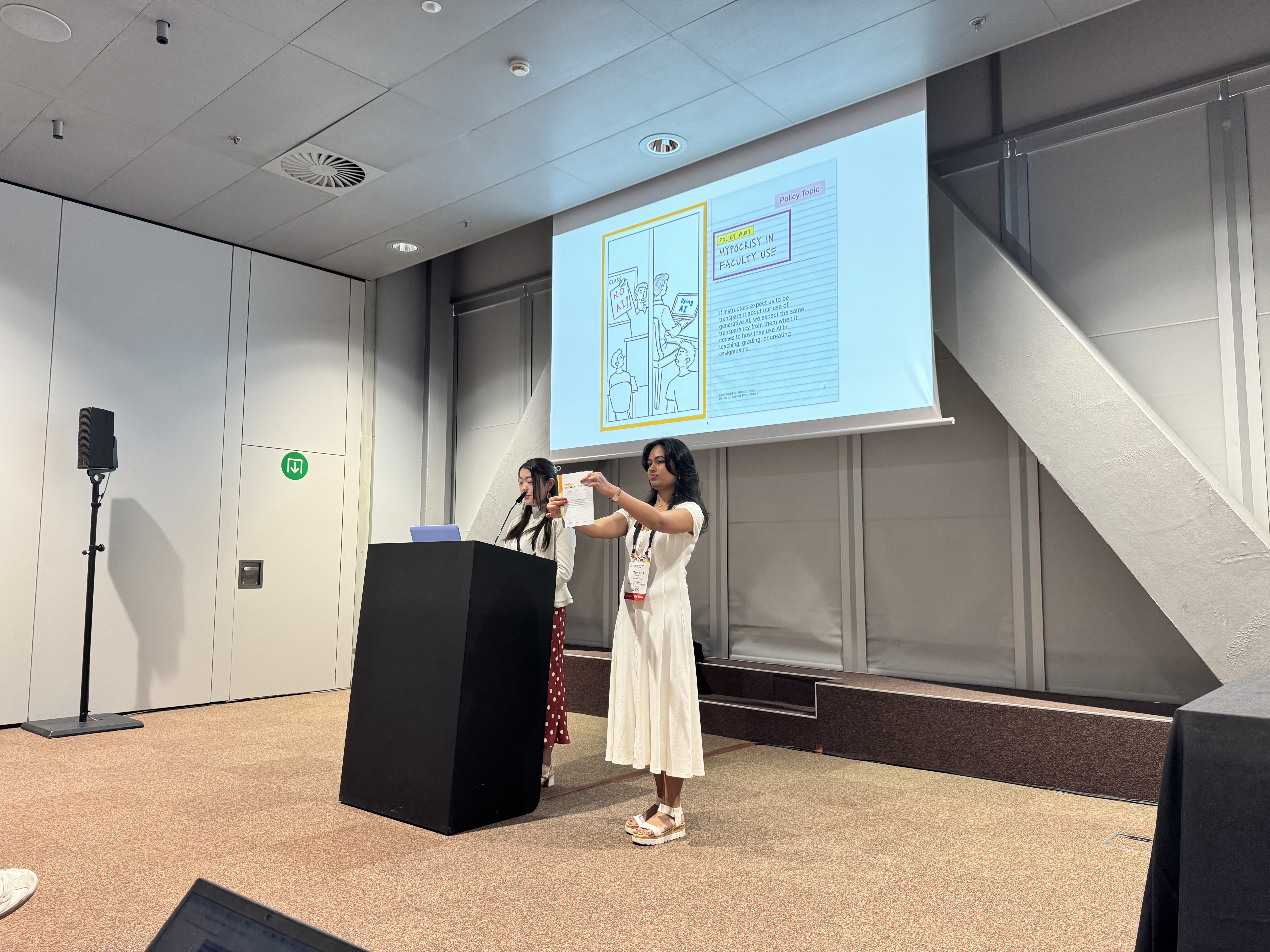
Manisha co-presented the policy paper as her first paper ever, and arrived nervous about measuring up to such a prestigious audience. Two things shifted that: Pep Gatell’s opening keynote, which left her with the advice to approach everything with a “hybrid brain” and stay close to people who think differently, and the simple realization — watching talk after talk — that she had already earned her place in the room:
I don’t have to prove myself to anyone. I already did that by submitting to the conference and getting accepted.
She also came away convinced that conferences are about the quality of the connections you make, not the quantity.
Read Manisha’s full reflection →
Qi came prepared like no one else — homemade cookies stamped “Kudos,” a photo printer, business cards, and a shirt with a QR code to his website — and talked with some 25 people at his poster. Beyond the logistics, the week sharpened a conviction about where good research comes from: that problems should emerge from communities and everyday observation rather than be handed down. Asked to define participation on a panel, he answered:
The definitions of participation can also be joy. And it has three levels of joy. The first level is compensation… The second level of joy is to accomplish their goals… The third level of joy is community partnership — a long-term commitment to make sure we don’t treat our participants as a one-time data source.
Onward
We’re grateful to everyone who made this trip possible — collaborators, the students who participated in our workshops, and the lab members who gave feedback late into the night. As Manisha put it, we’re leaving Barcelona resolved to stay curious, stay interdisciplinary, and keep talking to people who challenge how we think — and looking forward to CHI 2027 in Pittsburgh.